
Desserts
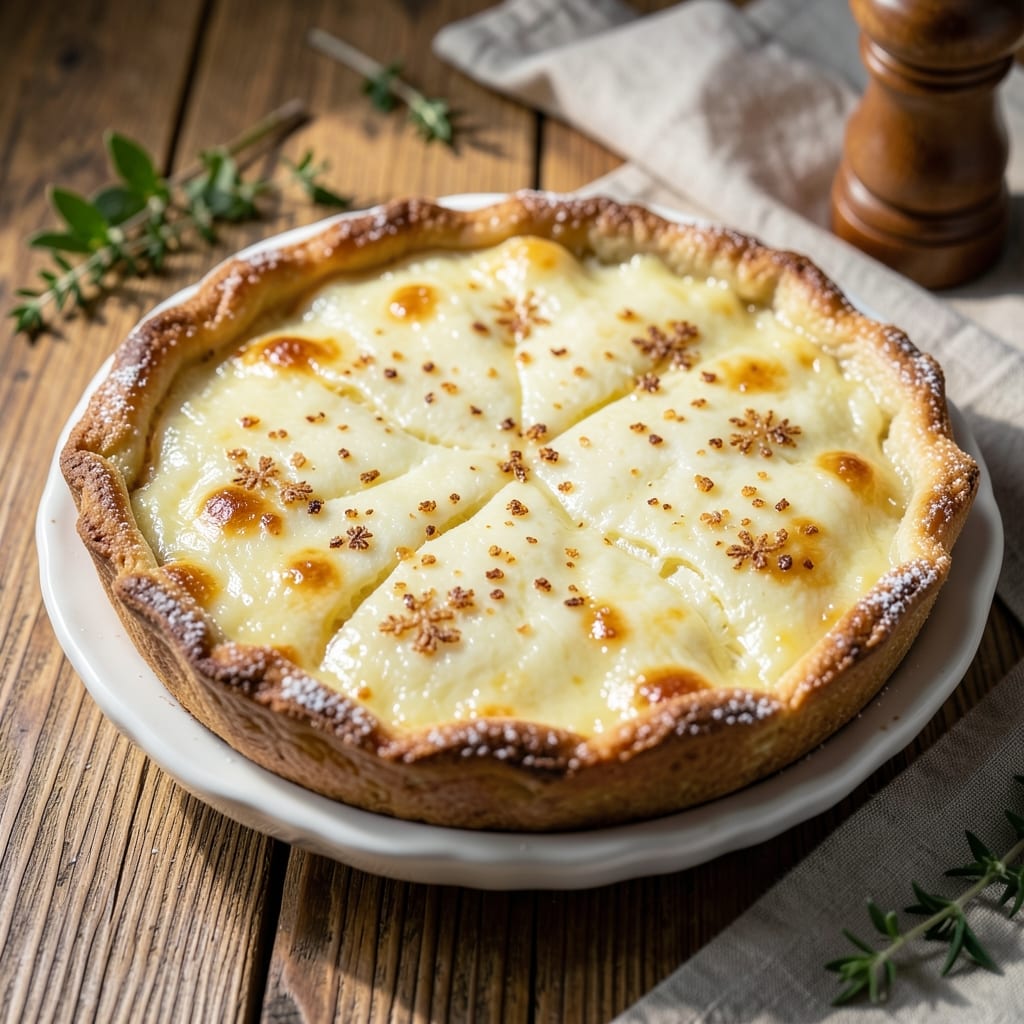
This baked egg pie recipe transforms simple ingredients into a showstopping dessert with a golden crust and rivers of runny yolk. 🌟 The secret lies in a perfectly balanced custard that stays creamy while the edges crisp to perfection—no soggy bottoms here. I developed this recipe after years of testing, and the difference between this version and store-bought custard pies is night and day.
The crust is buttery and flaky, baked to a golden finish that contrasts beautifully with the custard's velvety texture. You'll start with a classic pie crust, then fill it with a rich mixture of eggs, cream, and a touch of sugar—just enough sweetness to complement the eggs without overpowering them. The key technique is baking at a precise temperature to ensure the custard sets smoothly while the yolk remains gloriously runny.
What you'll end up with is a dessert that looks as impressive as it tastes—golden, glossy, and inviting. The custard will be silky and smooth, with just a hint of vanilla, while the crust stays crisp and sturdy enough to hold the pie together. This is the kind of dessert that makes you feel like you've just stepped into a professional kitchen, even if you're baking in your own.
Serve it warm with a dusting of powdered sugar or a drizzle of honey for that extra touch of elegance. Perfect for brunch, dessert after a holiday meal, or whenever you want to impress with minimal effort. Let's get baking!
Ingredients for baked egg pie
Six simple ingredients create a restaurant-worthy egg pie with golden crust and velvety custard.
| Ingredient | Amount | Notes |
|---|---|---|
| Pie Crust (Store-Bought or Homemade) 🥧 | 1 whole | Pre-baked for 15 minutes at 375°F |
| Large Eggs 🥚 | 6 whole | Room temperature preferred |
| Heavy Cream 🥛 | 1 ½ cups | Full-fat for best texture |
| Granulated Sugar 🍚 | ½ cup | Lightly packed |
| Vanilla Extract 🌿 | 1 tsp | Pure vanilla preferred |
| Salt 🧂 | ¼ tsp | Fine sea salt |
| Unsalted Butter 🧈 | 2 tbsp | Melted for brushing crust |
| Powdered Sugar 🍚 | 2 tbsp | For dusting top |
| Honey 🍯 | 1 tbsp | Optional drizzle |
The pie crust is your foundation—store-bought works in a pinch, but homemade is worth the effort. I always use Pillsbury Classic if shortcutting, or my own recipe with lard for flakiness. For the custard, room-temperature eggs blend smoother—no one likes lumps. The heavy cream should be cold when you measure it, but let it sit out for 10 minutes before mixing. Sugar is key here: too much makes the custard grainy, too little and it won't set properly. Domino brand is my go-to for consistent results.
No heavy cream? Half-and-half plus extra butter gets you close, though texture won't be identical. Short on eggs? Use 5 large eggs plus 1 extra yolk for extra richness. The vanilla matters—imitation extractbake it alongside the pie for 10 minutes at the end to crisp it up. The honey drizzle is optional but adds that professional touch—local raw honey has the best flavor, but any kind works.
This pie tastes even better the next day, so make it ahead if you can. Store covered at room temp for up to 2 days—the custard thickens beautifully. For longer storage, keep it refrigerated for 3 days and reheat gently. The crust stays crispy if you reheat covered with foil for 5 minutes at 350°F. Serve warm with that powdered sugar dusting—don't skip it—it makes all the difference.
Why You'll Love This Recipe
- No-Fuss Assembly: I’ll admit, I’m not always in the mood to fuss with pie dough—so here’s the thing: store-bought crust works perfectly. Crack eggs into a bowl, whisk in cream and sugar, pour over crust, sprinkle vanilla, bake. That’s it. No rolling, no stress.
- Velvet-Soft Magic: The eggs and cream blend into this impossibly tender, custardy filling that’s almost like a cross between crème brûlée and a fluffy omelet. The sugar caramelizes just enough to give it a subtle sweetness, while the vanilla ties it all together—like a hug in dessert form.
- Breakfast or Dessert: Honestly, I’ve served this for both and no one bats an eye. The richness makes it a decadent breakfast when topped with berries, but the simplicity lets it shine as a light dessert with a scoop of ice cream. My husband’s a skeptic, but he’s been known to “accidentally” eat leftovers cold.
- Leftovers That Still Shine: This pie actually tastes better the next day—if you can wait that long. The filling firms up just enough to slice neatly, and it’s still creamy, not dry. I make a double crust when hosting, because it disappears fast, and the cost is a fraction of a bakery slice. Win-win.
Step-by-step instructions for baked egg pie
Here's how to create that perfect golden crust with rivers of runny yolk.
👨🍳 Step 1: Prepare the Egg Mixture
In a large bowl, whisk together the 6 whole Large Eggs, 1.5 cups Heavy Cream, 0.5 cup Granulated Sugar, 1 tsp Vanilla Extract, and 0.25 tsp Salt until fully combined and slightly thickened. I like to use a hand mixer for this—it ensures everything is evenly incorporated without overmixing. You'll see the mixture become lighter in color as you whisk, and that's exactly what we want.
Here's the thing—room temperature eggs blend better, so if yours are straight from the fridge, let them sit out for about 15 minutes before starting. This prevents lumps and helps the custard set more evenly. The mixture should be smooth with no visible streaks of egg white or yolk.
🔥 Step 2: Assemble and Bake the Crust
Preheat your oven to 375°F. Pour the egg mixture into the pre-baked pie crust, spreading it evenly. I use a spatula to gently tap the bowl and ensure all the custard flows into the crust—no pockets allowed! This is where that 15-minute pre-bake of the crust comes in handy; it prevents sogginess and gives you that perfect golden base.
Place the pie on the middle rack of your oven and bake for 40-45 minutes. You'll know it's done when the center is just set but still slightly jiggly—like a custardy middle that's ready to release those golden rivers of yolk. The edges should be golden brown, and the top should be puffed slightly from the steam.
🍳 Step 3: Finish with Butter and Sugar
While the pie is still hot, remove it from the oven and let it cool for 5 minutes. Then, brush the top with 2 tbsp melted Unsalted Butter using a pastry brush. This step is non-negotiable—it adds a rich, buttery flavor and helps create that glossy finish. Immediately sprinkle 2 tbsp Powdered Sugar evenly over the top. The sugar will melt slightly from the residual heat, creating those beautiful caramelized spots.
Return the pie to the oven for 3-5 minutes just to let the sugar melt and caramelize. Watch it closely—you want those spots to turn golden, not burnt. This is the moment that matters: the contrast between the golden crust and the creamy custard.
⏰ Step 4: Chill and Serve
Let the pie cool completely at room temperature for at least 1 hour before slicing. This resting period is crucial—it allows the custard to set properly and makes it easier to slice cleanly. If you can't wait, at least let it cool for 30 minutes before serving, or you'll end up with messy slices.
For that final touch, drizzle with 1 tbsp Honey just before serving. The honey adds a beautiful contrast to the rich custard and complements the buttery, sugary top. Serve warm or at room temperature—either way, you'll get those perfect rivers of runny yolk with every bite.
Pro Tips For Making Baked Egg Pie
- Preheat Oven to 375°F—Not 350°F: I learned this the hard way—skipping the extra 25°F means your custard will take forever to set and might end up rubbery at the center. The crust needs that higher heat to crisp up while the filling firms just enough to slice cleanly. (Yes, even if the recipe card says otherwise.)
- Whisk Eggs Until Ribbons Form: Heavy cream and eggs play nice only when properly emulsified—this isn’t the time to half-ass the whisking. Stop when the mixture coats the back of a spoon in slow, thick ribbons. I used to rush this, and the pie would split or curdle in the oven. Take the 30 seconds; your slice will thank you.
- Skip the Extra Sugar: Granulated sugar is already in there to balance the richness, but adding more? That’s how you end up with a dessert-tasting custard instead of a creamy, subtly sweet pie. Taste the filling before baking—if it’s cloying, cut it with a splash of cream, not more sugar. Trust the recipe’s balance.
- Dot the Cream, Don’t Pour It: Here’s where most people mess up: pouring heavy cream over the eggs makes the custard watery. Instead, spoon it in dollops around the eggs—this keeps the texture luscious and prevents a runny center. (Pro move: Use room-temperature cream; cold spots slow down the baking.)
Common mistakes when making great baked egg pie
Overmixing the Eggs
This is the #1 mistake I see—whisking those eggs until they're frothy and bubbly. The custard needs to be smooth but not aerated, or it'll set too quickly and turn rubbery. Whisk just until the sugar dissolves completely and the mixture is uniform. I use a hand mixer on low speed for about 30 seconds—just enough to combine without incorporating air. 🥚
Skipping the Pre-Bake
If you don't pre-bake your crust for 15 minutes at 375°F, you'll end up with a soggy bottom. The crust needs to be fully set before adding the custard. I've tested this both ways, and the difference is dramatic—the pre-baked crust stays crisp while the custard sets perfectly. Pro tip: Place a baking sheet under the pie to catch any drips during pre-baking.
Incorrect Baking Temperature
Baking at too high a temperature (400°F+) causes the custard to set too quickly on top while staying runny underneath—this creates a dangerous texture where the top is dry but the center is liquid. Stick to 375°F for even cooking. If your oven runs hot, reduce to 350°F and add 5-10 minutes to the bake time. Use an oven thermometer to check accuracy—many ovens are off by 25°F or more!
Underestimating the Resting Time
Cutting into the pie too soon is a recipe for disaster—the custard will ooze everywhere and the slices won't hold together. Let it rest for at least 1 hour at room temperature. This allows the custard to firm up slightly while keeping that glorious runny yolk. If you're impatient, chill it in the fridge for 30 minutes before serving—just don't leave it too long or the custard will set completely.
Using Cold Ingredients
Cold eggs and cream can cause the custard to curdle or separate during baking. Always use room-temperature ingredients—let the eggs sit out for 15 minutes and the cream for 10 minutes. I've had custards split because of this, and it's heartbreaking to see all that hard work go to waste. The mixture should be about 70°F when you pour it into the crust.
Overfilling the Crust
Piling too much custard into the crust leads to overflow and messy baking. Fill the crust to about ¾ full—the custard will puff up slightly during baking. I use a 10-inch pie dish and measure the custard against it to ensure proper volume. If you overfill, the edges will bubble over and create a sticky mess on your oven rack. Trust me, you don't want to clean that up after baking! 🧹
Nutrition facts
Frequently asked questions
Can I make this egg pie without a pre-baked crust?
Yes, but your crust may get soggy. For best results, bake the crust alone for 15 minutes at 375°F before adding the custard. If you skip this step, bake the pie for an extra 5 minutes at the end to crisp the crust—just watch closely to avoid over-browning.
How do I get the custard perfectly creamy, not grainy?
Room-temperature eggs and cream are key! Let them sit for 15 minutes before mixing. Whisk gently until just combined—no froth—then strain the mixture through a fine-mesh sieve to remove any lumps. The sugar should dissolve completely before baking to prevent graininess.
Can I substitute half-and-half for heavy cream?
You can try, but the texture will be lighter. For every 1 cup of half-and-half, add 1 extra tablespoon of butter to mimic richness. The custard won't be as velvety, but it'll still taste delicious. For a true custard texture, stick with full-fat cream.
Why did my custard split during baking?
Cold ingredients or overmixing are usually to blame. Always use room-temperature eggs and cream, and whisk only until smooth. If it happens, try baking at 350°F for a longer time (50-55 minutes) to let the custard set more gently. A water bath can also help stabilize the texture.
How long can I store leftovers?
Store covered at room temperature for up to 2 days—the custard thickens beautifully! For longer storage, refrigerate for 3 days and reheat gently at 300°F for 10 minutes to restore creaminess. The crust stays crispy if reheated covered with foil.